
What is staff scheduling?
Staff scheduling is the process of deciding which employees work which shifts on which dates, so that every hour a workplace is open has the number of staff it needs on duty. It is also called employee scheduling, shift scheduling or rostering. The result is a staff schedule, also called a rota or roster.
Three numbers decide how many employees a schedule needs: the hours to cover, the number of staff on duty at a time, and the hours each employee works a week. The type of schedule then decides how those hours are divided into shifts and days off.
Staff scheduling calculator
Choose the shifts to cover, the days open, the staff needed on each shift, and the days on and days off in a row. The calculator shows the teams and employees needed, the hours and shifts per employee, and the shift patterns with the closest runs of work and breaks.
Matching shift patterns
| Pattern | Sequence | Days on | Days off | Teams | Average hours a week |
|---|
Patterns are listed by how close their runs of work and breaks are to the days on and days off entered.
The figures count scheduled shifts only.
How the calculator works
Share of days worked = days on ÷ (days on + days off)
Teams needed = shift types a day × (days open ÷ 7) ÷ share of days worked
Employees needed = teams × staff on duty per shift
Average hours a week = 7 × share of days worked × shift length
For example, 4 days on and 4 days off is a share of 4 ÷ 8 = one half. Covering day and night shifts 7 days a week then needs 2 ÷ ½ = 4 teams, and each employee averages 7 × ½ × 12 = 42 hours a week.
Shift patterns by days on and days off
Where a pattern has runs of work or breaks of different lengths, the table gives the range.
| Pattern | Shifts covered | Sequence | Days on in a row | Days off in a row | Cycle | Teams | Average hours a week |
|---|---|---|---|---|---|---|---|
| 2-2-4 | Day and night, 12-hour (24/7) | 2 days, 2 nights, 4 off | 4 | 4 | 8 days | 4 | 42 |
| 3 on 3 off (rotating) | Day and night, 12-hour (24/7) | 3 days, 3 off, 3 nights, 3 off | 3 | 3 | 12 days | 4 | 42 |
| 4 on 4 off (rotating) | Day and night, 12-hour (24/7) | 4 days, 4 off, 4 nights, 4 off | 4 | 4 | 16 days | 4 | 42 |
| 5 on 5 off (rotating) | Day and night, 12-hour (24/7) | 5 days, 5 off, 5 nights, 5 off | 5 | 5 | 20 days | 4 | 42 |
| 6 on 6 off | Day and night, 12-hour (24/7) | 3 days, 3 nights, 6 off | 6 | 6 | 12 days | 4 | 42 |
| 7 on 7 off (rotating) | Day and night, 12-hour (24/7) | 7 days, 7 off, 7 nights, 7 off | 7 | 7 | 28 days | 4 | 42 |
| 3-3-3 | Day and night, 12-hour (24/7) | 3 days, 3 nights, 3 off | 6 | 3 | 9 days | 3 | 56 |
| Panama (2-2-3) | Day and night, 12-hour (24/7) | 2 on, 2 off, 3 on, 2 off, 2 on, 3 off | 2–3 | 2–3 | 14 days (28 or 56 with the day/night swap) | 4 | 42 |
| DuPont | Day and night, 12-hour (24/7) | 4 nights, 3 off, 3 days, 1 off, 3 nights, 3 off, 4 days, 7 off | 3–4 | 1, 3 and 7 | 28 days | 4 | 42 |
| Reverse DuPont | Day and night, 12-hour (24/7) | 4 days, 3 off, 3 nights, 1 off, 3 days, 3 off, 4 nights, 7 off | 3–4 | 1, 3 and 7 | 28 days | 4 | 42 |
| Pitman (2-2-3) | Day and night, 12-hour (24/7) | 2 on, 2 off, 3 on, 2 off, 2 on, 3 off; fixed day and night teams | 2–3 | 2–3 | 14 days | 4 | 42 |
| 4-3-3-4 | Day and night, 12-hour (24/7) | 4 on, 3 off, 3 on, 4 off; fixed day and night teams | 3–4 | 3–4 | 14 days | 4 | 42 |
| 5-5-2-2 | Day and night, 12-hour (24/7) | 5 on, 5 off, 2 on, 2 off; fixed day and night teams | 2–5 | 2–5 | 14 days | 4 | 42 |
| Southern Swing | Morning, afternoon and night, 8-hour (24/7) | 7 mornings, 2 off, 7 afternoons, 2 off, 7 nights, 3 off | 7 | 2–3 | 28 days | 4 | 42 |
| Pitman (one shift type) | Days only or nights only, 12-hour | 2 on, 2 off, 3 on, 2 off, 2 on, 3 off | 2–3 | 2–3 | 14 days | 2 | 42 |
| Fixed 3 on 3 off | Days only or nights only, 12-hour | 3 on, 3 off | 3 | 3 | 6 days | 2 | 42 |
| Fixed 4 on 4 off | Days only or nights only, 12-hour | 4 on, 4 off | 4 | 4 | 8 days | 2 | 42 |
| Fixed 5 on 5 off | Days only or nights only, 12-hour | 5 on, 5 off | 5 | 5 | 10 days | 2 | 42 |
| Fixed 6 on 6 off | Days only or nights only, 12-hour | 6 on, 6 off | 6 | 6 | 12 days | 2 | 42 |
| Fixed 7 on 7 off | Days only or nights only, 12-hour | 7 on, 7 off | 7 | 7 | 14 days | 2 | 42 |
| 4-3-3-4 (one shift type) | Days only or nights only, 12-hour | 4 on, 3 off, 3 on, 4 off, with a partner team on 3-3-4-4 | 3–4 | 3–4 | 14 days | 2 | 42 |
| 5-5-2-2 (one shift type) | Days only or nights only, 12-hour | 5 on, 5 off, 2 on, 2 off, with a partner team on 5-2-2-5 | 2–5 | 2–5 | 14 days | 2 | 42 |
| 5 on 2 off (Monday to Friday) | Daytime work week | 5 on, 2 off | 5 | 2 | 7 days | 1 (5 days a week) | 40 |
| 4/10 | Daytime work week | 4 ten-hour days, 3 off | 4 | 3 | 7 days | 1 (4 days a week) | 40 |
| 9/80 | Daytime work week | Eight 9-hour days and one 8-hour day in two weeks | 4–5 | 2–3 | 14 days | 1 (weekdays) | 40 |
| 3/12 | Daytime work week | 3 twelve-hour shifts, 4 off | 3 | 4 | 7 days | Set by the days covered | 36 |
The staffing formula
Staff hours a week = hours open per day × days open per week × staff on duty
Employees needed = staff hours a week ÷ hours a week per employee
The result is in full-time equivalents (FTE). A result of 4.2 means 4.2 employees’ worth of hours, which can be filled by five employees, or by four employees plus 8 hours a week of part-time work or overtime.
| Hours open | Staff on duty | Shift length | Hours a week per employee | Staff hours a week | FTE | Employees, rounded up |
|---|---|---|---|---|---|---|
| 24 hours × 7 days | 1 | 12 hours | 42 hours | 24×7×1 = 168 | 4 | 4 |
| 24 hours × 7 days | 1 | 8 hours | 40 hours | 24×7×1 = 168 | 4.2 | 5 |
| 24 hours × 7 days | 3 | 12 hours | 42 hours | 24×7×3 = 504 | 12 | 12 |
| 16 hours × 7 days | 2 | 8 hours | 40 hours | 16×7×2 = 224 | 5.6 | 6 |
| 10 hours × 6 days | 4 | 10 hours | 40 hours | 10×6×4 = 240 | 6 | 6 |
| 12 hours × 5 days | 2 | 12 hours | 36 hours | 12×5×2 = 120 | 3.33 | 4 |
A position open 24 hours a day, 7 days a week needs 168 staff hours a week for each person on duty. At 42 hours a week that is exactly 4 employees; at 40 hours a week it is 4.2.
Types of staff schedules
Fixed schedule
Each employee works the same shifts on the same days every week, for example Monday to Friday on day shifts.
Rotating schedule
Employees move between shift types, such as days and nights, or mornings, afternoons and nights, in a repeating cycle. Teams work the same rotation from different starting dates so that every shift is covered. DuPont and Panama are rotating 12-hour schedules; the Southern Swing below is a rotating 8-hour schedule.
Compressed workweek
The weekly hours are worked in fewer, longer days.
- 4/10: four 10-hour days a week, 40 hours, with three days off.
- 9/80: 80 hours over two weeks in nine days: eight 9-hour days and one 8-hour day, with one weekday off every two weeks.
- 3/12: three 12-hour shifts a week, 36 hours.
Split shift
One working day divided into two parts with a gap between them, for example a morning part and an evening part.
Staggered schedule
Employees start and finish at different times, so that the number of staff on duty changes through the day.
On-call schedule
Employees are available to be called in to work during set periods, in addition to or instead of scheduled shifts.
Flexible schedule (flextime)
Employees choose their start and finish times within set limits, such as fixed core hours.
Types of shifts
- Day shift: a shift worked during daytime hours.
- Morning or early shift: the first of three shifts on an 8-hour, 24-hour rotation.
- Afternoon, evening, late or swing shift: the shift between the morning and night shifts on a three-shift rotation.
- Night or graveyard shift: a shift worked through the night, starting in the evening and ending the next morning.
- Split shift: one working day in two parts with a gap between them.
- Double shift: two consecutive shifts worked by the same person.
- On-call shift: a period in which an employee can be called in to work.
Start and finish times for each shift type are set by each workplace.
24/7 with 8-hour shifts: the Southern Swing
Covering 24 hours with 8-hour shifts takes three shifts a day: morning, afternoon and night. The Southern Swing is a rotating 8-hour schedule for four teams on a 28-day cycle. Each team works seven morning shifts, has two days off, works seven afternoon shifts, has two days off, works seven night shifts and has three days off.
The four teams start the cycle seven days apart. On every date one team is on mornings, one on afternoons, one on nights, and one is off.
Southern Swing: four teams across one 28-day cycle (day 1 = Monday)
| Day | 1 | 2 | 3 | 4 | 5 | 6 | 7 | 8 | 9 | 10 | 11 | 12 | 13 | 14 | 15 | 16 | 17 | 18 | 19 | 20 | 21 | 22 | 23 | 24 | 25 | 26 | 27 | 28 |
|---|---|---|---|---|---|---|---|---|---|---|---|---|---|---|---|---|---|---|---|---|---|---|---|---|---|---|---|---|
| Mo | Tu | We | Th | Fr | Sa | Su | Mo | Tu | We | Th | Fr | Sa | Su | Mo | Tu | We | Th | Fr | Sa | Su | Mo | Tu | We | Th | Fr | Sa | Su | |
| Team A | M | M | M | M | M | M | M | · | · | A | A | A | A | A | A | A | · | · | N | N | N | N | N | N | N | · | · | · |
| Team B | N | N | N | N | · | · | · | M | M | M | M | M | M | M | · | · | A | A | A | A | A | A | A | · | · | N | N | N |
| Team C | A | A | · | · | N | N | N | N | N | N | N | · | · | · | M | M | M | M | M | M | M | · | · | A | A | A | A | A |
| Team D | · | · | A | A | A | A | A | A | A | · | · | N | N | N | N | N | N | N | · | · | · | M | M | M | M | M | M | M |
| Morning cover | ✓ | ✓ | ✓ | ✓ | ✓ | ✓ | ✓ | ✓ | ✓ | ✓ | ✓ | ✓ | ✓ | ✓ | ✓ | ✓ | ✓ | ✓ | ✓ | ✓ | ✓ | ✓ | ✓ | ✓ | ✓ | ✓ | ✓ | ✓ |
| Afternoon cover | ✓ | ✓ | ✓ | ✓ | ✓ | ✓ | ✓ | ✓ | ✓ | ✓ | ✓ | ✓ | ✓ | ✓ | ✓ | ✓ | ✓ | ✓ | ✓ | ✓ | ✓ | ✓ | ✓ | ✓ | ✓ | ✓ | ✓ | ✓ |
| Night cover | ✓ | ✓ | ✓ | ✓ | ✓ | ✓ | ✓ | ✓ | ✓ | ✓ | ✓ | ✓ | ✓ | ✓ | ✓ | ✓ | ✓ | ✓ | ✓ | ✓ | ✓ | ✓ | ✓ | ✓ | ✓ | ✓ | ✓ | ✓ |
Swipe the table sideways to see every day of the cycle.
M = morning shift, A = afternoon shift, N = night shift, · = off. The bottom three rows check every date: ✓ means exactly one team is on that shift.
Each team works 21 shifts of 8 hours in 28 days: 168 hours, an average of 42 hours a week. The rotation runs forward, from mornings to afternoons to nights. The reverse version runs nights, then afternoons, then mornings.
- Most shifts in a row: 7.
- Breaks: 2, 2 and 3 days.
- Shifts a year per person: about 274, including about 91 nights.
- Fully free weekends a year with day 1 on a Monday: 13. A weekend counts only if the Saturday and Sunday are both off and no night shift starts on the Friday.
8-hour and 12-hour 24/7 schedules compared
| 8-hour shifts | 12-hour shifts | |
|---|---|---|
| Shifts a day | 3 (morning, afternoon, night) | 2 (day, night) |
| Teams for 24/7 at 42 hours a week | 4 | 4 |
| Shifts a year per person at 42 hours a week | About 274 | About 183 |
| Days a year with no shift starting | About 91 | About 183 |
| Handovers a day | 3 | 2 |
| Shift types per person on a rotating schedule | 3 | 2 |
Both cover 168 hours a week per position with four teams. With 8-hour shifts each person works more shifts, each shorter; with 12-hour shifts each person works fewer, longer shifts and has more days with no shift starting. The 12-hour 24/7 patterns, including DuPont, Panama, Pitman, 2-2-4 and 4 on 4 off, are compared on the shift patterns page.
Staff scheduling terms
- Coverage: having the required number of staff on duty at every hour the workplace is open.
- Full-time equivalent (FTE): scheduled hours divided by the hours of one full-time employee.
- Headcount: the number of employees, whatever their hours.
- Staff hours: hours open × staff on duty.
- Cycle: the number of days before a rotating schedule repeats.
- Team: a group of employees who work the same schedule on the same dates.
- Handover: the change from one shift to the next.
- Open shift: a scheduled shift with no employee assigned.
- Shift swap: two employees exchanging scheduled shifts.
- Relief: staff used to fill shifts when scheduled employees are absent.
- Overtime: hours worked beyond an employee’s contracted hours.
ShiftShow for shift workers
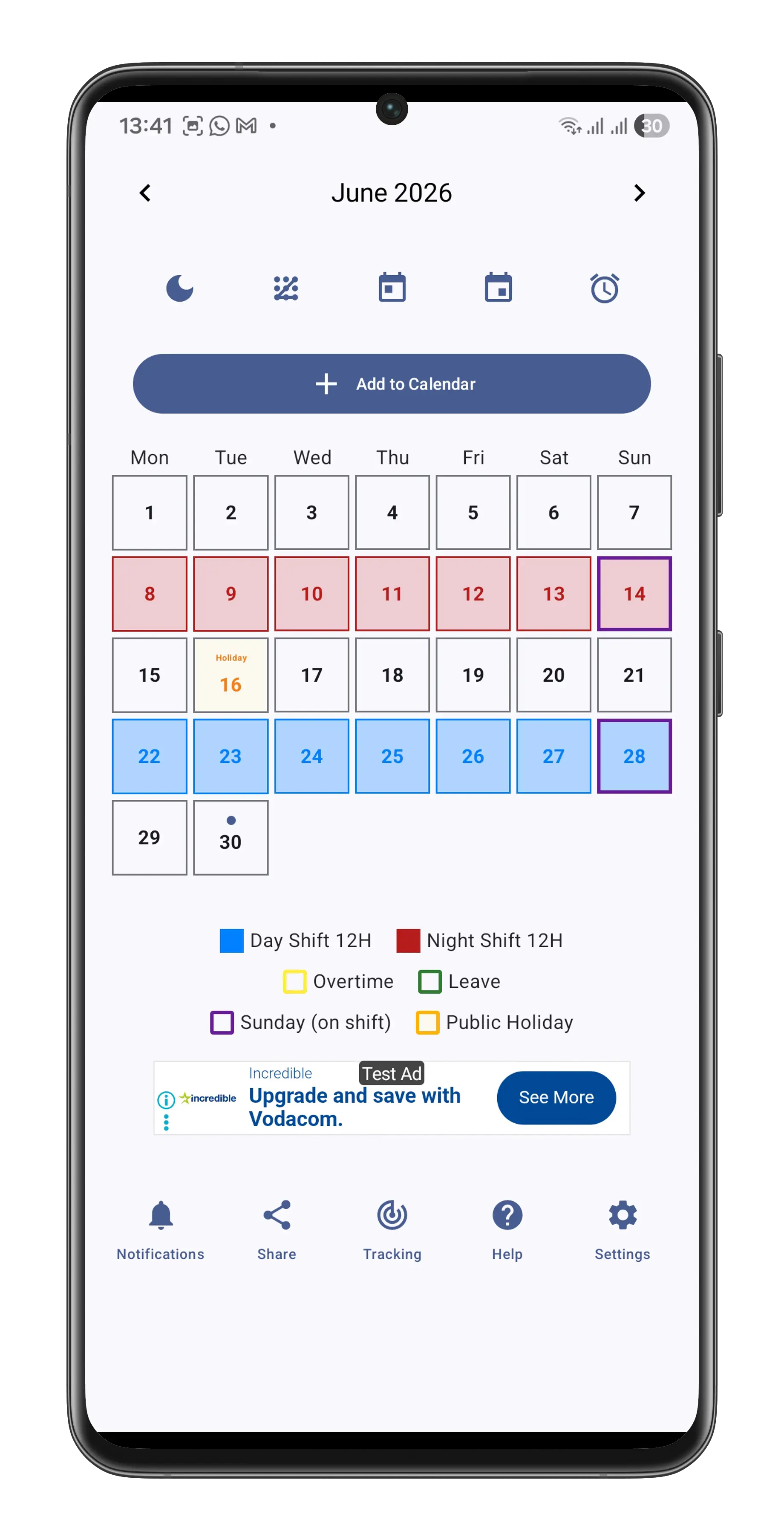
ShiftShow is a free shift calendar app for Android. Each employee enters their schedule once with the Smart Shift Builder, including rotating schedules, and the app shows their shifts up to 20 years ahead with an alarm that adjusts to each shift. Managers can combine employees’ ShiftShow hours exports in Manager’s Desk.
Get ShiftShow for AndroidStaff scheduling FAQ
What is staff scheduling?
Staff scheduling is deciding which employees work which shifts on which dates so that every hour a workplace is open has the staff it needs on duty. It is also called employee scheduling, shift scheduling or rostering.
How do you calculate how many staff you need?
Multiply the hours open per day by the days open per week and by the staff needed on duty at a time. Divide the result by the hours each employee works a week. The answer is in full-time equivalents.
How many employees do you need for 24/7 coverage?
For each person on duty, 168 staff hours a week. That is 4 full-time equivalents at 42 hours a week, or 4.2 at 40 hours a week.
Which shift patterns have 4 days on and 4 days off?
2-2-4 (two day shifts, two night shifts, four off) and 4 on 4 off, which runs as a rotating 16-day schedule (four days, four off, four nights, four off) or with fixed day and night teams. Both use four teams for 24/7 cover with 12-hour shifts.
What is a 4/10 schedule?
A compressed workweek of four 10-hour days, 40 hours a week, with three days off.
What is a 9/80 schedule?
A compressed schedule of 80 hours over two weeks in nine working days: eight 9-hour days and one 8-hour day, with one weekday off every two weeks.
What is the Southern Swing schedule?
A rotating 8-hour schedule for four teams on a 28-day cycle: seven mornings, two off, seven afternoons, two off, seven nights and three off. It averages 42 hours a week.
What is a swing shift?
The afternoon or evening shift between the morning and night shifts on a three-shift rotation.
What is the difference between a staff schedule and a shift pattern?
A staff schedule, rota or roster lists which employee works each shift on each date. A shift pattern is a repeating sequence of shifts and days off that a schedule can be built from.
12-hour shift pattern guides
2-2-4: 2 Days, 2 Nights, 4 Off
An 8-day, four-team rota with no more than two nights in a row.
Read the guide →3 On 3 Off Shift Pattern
Three days, three off, three nights, three off on a 12-day cycle, plus the fixed 6-day version.
Read the guide →3-3-3: 3 Days, 3 Nights, 3 Off
A 9-day rota that covers 24/7 with three teams, so each person works two days in every three.
Read the guide →4 On 4 Off Shift Pattern
Four days, four off, four nights, four off on a 16-day cycle, plus the fixed version with permanent day and night teams.
Read the guide →4 On 3 Off, 3 On 4 Off (4-3-3-4)
Four on, three off, three on, four off on a 14-day cycle, with a partner team on 3-3-4-4.
Read the guide →5 On 5 Off (5 In 5 Out)
Five shifts, five off: the fixed 10-day and rotating 20-day versions, plus the 14-day 5-5-2-2 pair.
Read the guide →6 On 6 Off: 3 Days, 3 Nights, 6 Off
Three days, three nights, then six days off on a 12-day cycle with four teams.
Read the guide →7 On 7 Off (7 In 7 Out)
Seven shifts in a row followed by seven days off.
Read the guide →DuPont Work Schedule
A 28-day, four-team rotation with seven days off in a row every cycle.
Read the guide →Modified DuPont Schedules
Reverse DuPont, five-team versions and other variations of the standard 28-day rotation.
Read the guide →Panama Shift Pattern (2-2-3)
The 14-day 2-2-3 rhythm with teams rotating between days and nights and, with a Monday start, a three-day weekend every other week.
Read the guide →Pitman Schedule
The same 2-2-3 rhythm, with two teams fixed on days and two fixed on nights.
Read the guide →