
What is the 6 on 6 off shift pattern?
The 6 on 6 off shift pattern is a 12-day rotation: three day shifts, three night shifts, then six days off. Four teams start the cycle three days apart, so on every date one team is on days, one is on nights and two are off. With 12-hour shifts each person works half the days of the year.
The pattern comes back to the same weekdays after 84 days. If your rota has six day shifts or six night shifts in one block instead, see blocks of six below.
One full cycle, in order
The 12-day cycle on a calendar
This example shows one team starting its day shifts on a Monday:
Twelve days is one week and five days, so each new cycle starts two weekdays earlier than the last: Monday, then Saturday, then Thursday. After seven cycles, 84 days or exactly 12 weeks, the rota is back on the same weekdays.
How four teams cover 24/7
Each team starts the same 12-day cycle three days after the one before.
6 on 6 off: all four teams across one 12-day cycle
| Day | 1 | 2 | 3 | 4 | 5 | 6 | 7 | 8 | 9 | 10 | 11 | 12 |
|---|---|---|---|---|---|---|---|---|---|---|---|---|
| Team A | D | D | D | N | N | N | · | · | · | · | · | · |
| Team B | · | · | · | D | D | D | N | N | N | · | · | · |
| Team C | · | · | · | · | · | · | D | D | D | N | N | N |
| Team D | N | N | N | · | · | · | · | · | · | D | D | D |
| Day cover | ✓ | ✓ | ✓ | ✓ | ✓ | ✓ | ✓ | ✓ | ✓ | ✓ | ✓ | ✓ |
| Night cover | ✓ | ✓ | ✓ | ✓ | ✓ | ✓ | ✓ | ✓ | ✓ | ✓ | ✓ | ✓ |
Swipe the table sideways to see every day of the cycle.
D = day shift, N = night shift, · = off. The bottom two rows check every date: ✓ means exactly one team is on that shift.
The team on nights is always the team that was on days three days earlier. Four teams each working 6 shifts in 12 days supply exactly the 24 shifts the cycle needs, so the rotation has no spare team. Unless teams carry more people than each shift needs, any absence that needs covering means overtime, relief staff or a fifth team.
Hours, nights and days off
Each team works 6 shifts in every 12 days: 72 hours with 12-hour shifts. Averaged over the cycle that is 42 hours a week, but because 12 days is not a whole number of weeks, some calendar weeks have more shifts than others. Over a year that averages about 183 shifts, roughly 91 of them nights, and about 183 days with no shift starting.
The third day shift ends in the evening and the first night shift starts the following evening, so there is one night not at work between the two blocks. After the third night there are six nights at home before the next day shift. The six-day break starts with you finishing the third night shift that morning.
Weekends off on 6 on 6 off
About 17 fully free weekends a year on average. The number in any particular year ranges from 16 to 18, depending on where the cycle falls.
A weekend counts as free only if you are not at work at any point on the Saturday or Sunday, so a night shift starting on Friday evening rules it out. Because the cycle moves across the week, the start weekday does not change the average.
Blocks of six days or six nights
Rotas that put six shifts of one type in a row, followed by six days off, work differently from the 3 days, 3 nights, 6 off plan:
| Version | Sequence | Cycle | Most nights in a row | Free weekends a year |
|---|---|---|---|---|
| Rotating | 6 days, 6 off, 6 nights, 6 off | 24 days | 6 | About 20 (18 to 21) |
| Fixed day team | 6 days, 6 off | 12 days | 0 | About 22 (21 to 23) |
| Fixed night team | 6 nights, 6 off | 12 days | 6 | About 17 (16 to 18) |
Both use four teams. On the rotating version they start six days apart; on the fixed version two teams alternate on days and two on nights. Twenty-four days is three weeks and three days, so the rotating cycle starts three weekdays later each time and returns to the same weekdays after 168 days. The 12-day fixed cycle starts two weekdays earlier each time and returns after 84 days.
6 on 6 off compared with similar rotas
| Pattern | Sequence | Cycle | Teams | Most shifts in a row | Break | Free weekends a year |
|---|---|---|---|---|---|---|
| 2-2-4 | 2 days, 2 nights, 4 off | 8 days | 4 | 4 | 4 days | About 13 |
| 3-3-3 | 3 days, 3 nights, 3 off | 9 days | 3 | 6 | 3 days | About 6 |
| 6 on 6 off | 3 days, 3 nights, 6 off | 12 days | 4 | 6 | 6 days | About 17 |
2-2-4 and 6 on 6 off both work half the days with four teams; 3-3-3 works two days in every three with three teams. 6 on 6 off has the same six-shift run as 3-3-3 with twice the break.
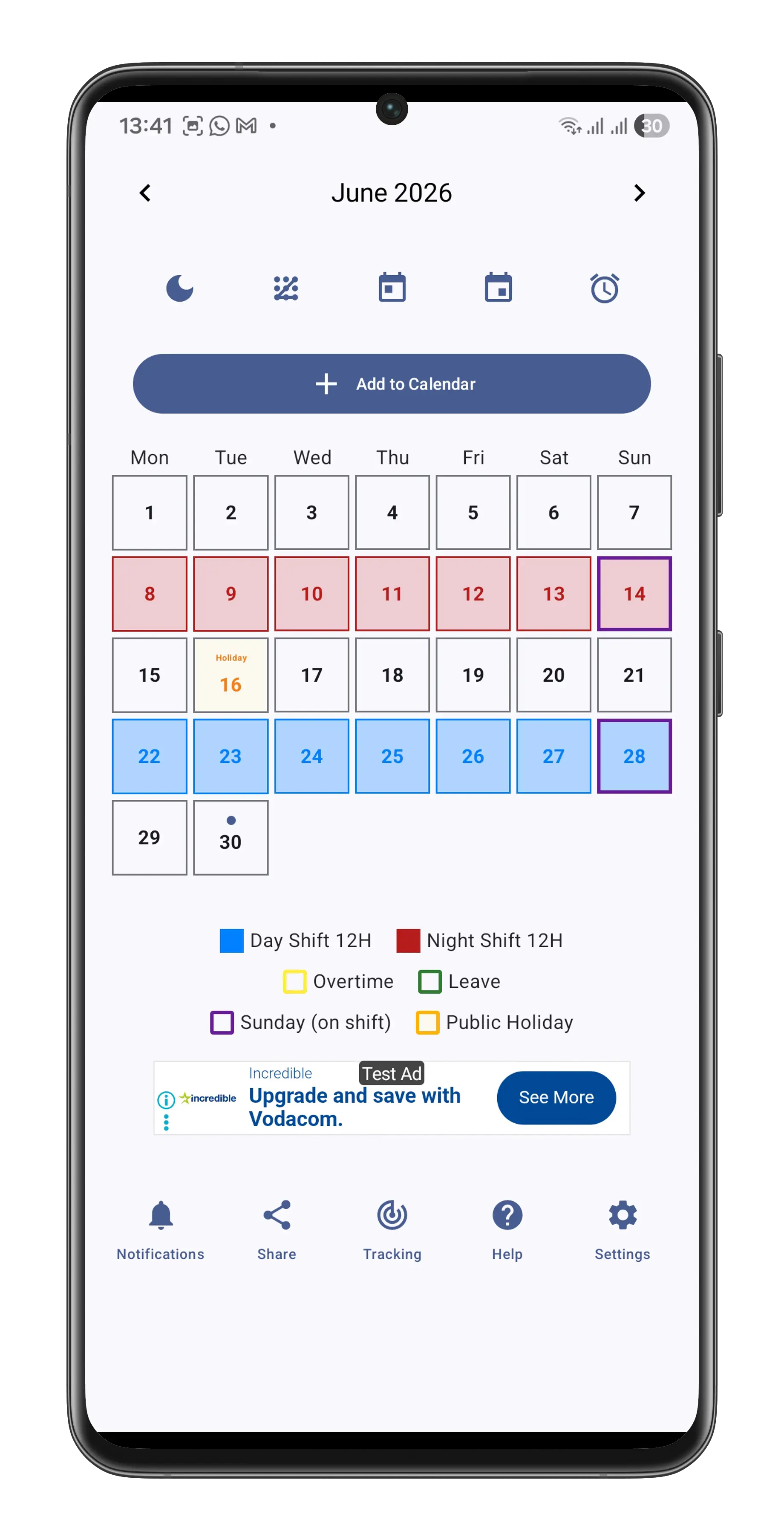
Set up 6 on 6 off in ShiftShow
- Open Smart Shift Builder and choose the date of your first day shift.
- Add three blocks: 3 days, 3 nights, 6 off. For the rotating blocks-of-six version add 6 days, 6 off, 6 nights, 6 off instead.
- Set your shift times. ShiftShow then repeats the pattern for years ahead.
The calendar shows which weekends you have off as the cycle moves across the week, and the alarm adjusts to each day or night shift.
Get ShiftShow for Android6 on 6 off FAQ
What is a 6 on 6 off shift pattern?
Three day shifts, three night shifts, then six days off, repeating every 12 days. Four teams starting three days apart cover 24 hours a day with 12-hour shifts.
How many hours a week is 6 on 6 off?
With 12-hour shifts you work six shifts, 72 hours, in every 12 days. Averaged over the cycle that is 42 hours a week.
How is 6 on 6 off different from 3-3-3?
Both start with three day shifts followed by three night shifts. 3-3-3 then has three days off and uses three teams, so each person works two days in every three. 6 on 6 off has six days off and uses four teams, so each person works half the days.
How many weekends off do you get on 6 on 6 off?
About 17 fully free weekends a year, between 16 and 18 in any given year.
What if my rota is six days, six off, six nights, six off?
That is a 24-day rotation with four teams starting six days apart. It has up to six nights in a row and gives about 20 fully free weekends a year.
How many teams does 6 on 6 off need?
Four with 12-hour shifts. On every date one team is on days, one is on nights and two are off.
Explore other shift patterns
2-2-4: 2 Days, 2 Nights, 4 Off
An 8-day, four-team rota with no more than two nights in a row.
Read the guide →3 On 3 Off Shift Pattern
Three days, three off, three nights, three off on a 12-day cycle, plus the fixed 6-day version.
Read the guide →3-3-3: 3 Days, 3 Nights, 3 Off
A 9-day rota that covers 24/7 with three teams, so each person works two days in every three.
Read the guide →4 On 4 Off Shift Pattern
Four days, four off, four nights, four off on a 16-day cycle, plus the fixed version with permanent day and night teams.
Read the guide →4 On 3 Off, 3 On 4 Off (4-3-3-4)
Four on, three off, three on, four off on a 14-day cycle, with a partner team on 3-3-4-4.
Read the guide →5 On 5 Off (5 In 5 Out)
Five shifts, five off: the fixed 10-day and rotating 20-day versions, plus the 14-day 5-5-2-2 pair.
Read the guide →7 On 7 Off (7 In 7 Out)
Seven shifts in a row followed by seven days off.
Read the guide →DuPont Work Schedule
A 28-day, four-team rotation with seven days off in a row every cycle.
Read the guide →Modified DuPont Schedules
Reverse DuPont, five-team versions and other variations of the standard 28-day rotation.
Read the guide →Panama Shift Pattern (2-2-3)
The 14-day 2-2-3 rhythm with teams rotating between days and nights and, with a Monday start, a three-day weekend every other week.
Read the guide →Pitman Schedule
The same 2-2-3 rhythm, with two teams fixed on days and two fixed on nights.
Read the guide →