
What is the Pitman schedule?
The Pitman schedule is a 14-day rotation of 12-hour shifts: two shifts on, two off, three on, two off, two on, three off. Four crews cover 24/7. Two are permanent day crews and two are permanent night crews, and within each pair one crew works exactly the days the other has off.
Naming varies. Employers and scheduling guides do not use Pitman, Panama and 2-2-3 consistently, and some treat them as the same thing. On ShiftShow we use Pitman for the fixed-crew arrangement and Panama for the version where crews rotate between days and nights. If your roster moves you from days to nights every few weeks, see our Panama schedule guide instead.
A day crew’s fortnight, in order
The fortnight, day by day
With day 1 on a Monday, every crew’s fortnight looks like this, whether on days or nights:
| Mon | Tue | Wed | Thu | Fri | Sat | Sun | |
|---|---|---|---|---|---|---|---|
| Week 1 | Work | Work | Off | Off | Work | Work | Work |
| Week 2 | Off | Off | Work | Work | Off | Off | Off |
The partner crew on the same shift works the mirror image, with its week 1 falling in your week 2. So one of you is always on duty, and your long weekends alternate.
Day crew calendar
Night crew calendar
How the four crews fit together
Pitman: two day crews and two night crews across one 14-day cycle (day 1 = Monday)
| Day | 1 | 2 | 3 | 4 | 5 | 6 | 7 | 8 | 9 | 10 | 11 | 12 | 13 | 14 |
|---|---|---|---|---|---|---|---|---|---|---|---|---|---|---|
| Mo | Tu | We | Th | Fr | Sa | Su | Mo | Tu | We | Th | Fr | Sa | Su | |
| Crew A (days) | D | D | · | · | D | D | D | · | · | D | D | · | · | · |
| Crew B (days) | · | · | D | D | · | · | · | D | D | · | · | D | D | D |
| Crew C (nights) | N | N | · | · | N | N | N | · | · | N | N | · | · | · |
| Crew D (nights) | · | · | N | N | · | · | · | N | N | · | · | N | N | N |
| Day cover | ✓ | ✓ | ✓ | ✓ | ✓ | ✓ | ✓ | ✓ | ✓ | ✓ | ✓ | ✓ | ✓ | ✓ |
| Night cover | ✓ | ✓ | ✓ | ✓ | ✓ | ✓ | ✓ | ✓ | ✓ | ✓ | ✓ | ✓ | ✓ | ✓ |
Swipe the table sideways to see every day of the cycle.
D = day shift, N = night shift, · = off. The bottom two rows check every date: ✓ means exactly one crew is on that shift.
Two features make the Pitman roster tidy:
- Mirror pairs. Crew B’s fortnight is crew A’s shifted by one week, which is exactly the days A has off. The same goes for C and D on nights. Every date has one day crew and one night crew.
- Fixed evening handovers. In the arrangement shown, crews A and C work the same dates, so the day crew A always hands over to C in the evening. B and D form the other pair. Morning handovers mix: at the end of a block, the night crew hands over to the other day crew. The night crews can also be offset differently, which still covers the clock but mixes the evening handovers too.
Cover is exact: 28 shifts per fortnight from four crews working seven each. Unless crews carry extra people, absences need overtime or relief staff.
Hours and time off
Seven 12-hour shifts per 14 days is 84 hours a fortnight. With a Monday start that is five shifts one week and two the next, which averages 42 hours a week over the fortnight: about 183 shifts a year and about 183 days with no shift starting. For a night crew, all of those shifts are nights.
No run of work is longer than three shifts and no break is longer than three days. With a Monday start, every other week ends in a three-day weekend from Friday to Sunday. For night crews that Friday starts with finishing Thursday’s night shift that morning, so it is part recovery day.
With a Monday start, the quiet week makes leave go a long way. Book its two shifts, Wednesday and Thursday, and you get a full week off for two days of leave. Add the Monday and Tuesday after it and you get 11 days in a row for four days of leave.
Weekends on the Pitman schedule
The Friday-to-Sunday weekends depend on the Monday anchor. For day crews some other start days still give 26 free weekends a year, though not always three days long. For night crews only the Monday anchor works. With any other start day, a Friday, Saturday or Sunday night shift always lands in the way.
| Day 1 is a… | Day crews | Night crews |
|---|---|---|
| Monday | 26 (all three-day) | 26 (all three-day) |
| Tuesday | 26 | 0 |
| Wednesday | 0 | 0 |
| Thursday | 26 | 0 |
| Friday | 0 | 0 |
| Saturday | 26 | 0 |
| Sunday | 0 | 0 |
A weekend counts as free only if you are not at work at any point on the Saturday or Sunday, so a night shift starting on Friday evening rules it out.
Fixed nights: the trade-off at the heart of Pitman
Nobody switches between days and nights. Day crews never work nights, and night crews keep the same routine every fortnight. For people who prefer nights, Pitman lets them stay on them.
The cost is that half the workforce are permanent night shift workers. A 2012 white paper on the US Department of Transportation’s PHMSA website says that, without the careful use of specialised devices and methods, only about 1% of people can adapt to night work, and that humans function quite poorly when required to work at night and sleep during the day. The UK Health and Safety Executive’s guidance is to offer a choice of permanent or rotating shifts and to try to avoid permanent night shifts.
Staffing night crews with people who choose nights follows the HSE’s advice to offer a choice. If no one wants permanent nights, the rotating Panama version shares them out instead.
Pros and cons of the Pitman schedule
Advantages
- No switching between days and nights.
- Never more than three shifts in a row.
- A three-day weekend every other week, 26 a year with a Monday anchor.
- The same weekdays every fortnight, so routines are easy to build.
- In the arrangement shown, the same evening handover partners every time.
Disadvantages
- Permanent nights for half the workforce.
- No long break without using leave.
- With a Monday start, busy and quiet weeks alternate (five shifts, then two).
- Night crews may see less of day-time managers and training.
- No spare crew in the rotation, so absence means overtime or relief cover unless crews carry extra people.
How Pitman compares with HSE guidance
This check uses the night crews’ calendar, the more demanding of the two:
| HSE guideline (summarised) | This pattern | Verdict |
|---|---|---|
| Restrict long shifts and night shifts to 2–3 in a row | Up to 3 twelve-hour shifts in a row, including up to 3 nights | Within guidance |
| Limit consecutive work days to a maximum of 5–7 | 3 days at most | Within guidance |
| Allow two nights' full sleep when switching between days and nights | No switching: each crew stays on one shift type | Not applicable |
| Rotate every 2–3 days or every 3–4 weeks; otherwise rotate forwards | Crews do not rotate: each stays on days or on nights | Not applicable |
| Offer a choice of permanent or rotating shifts and try to avoid permanent night shifts | Night crews work permanent nights | Outside guidance |
| Limit shifts to 12 hours including overtime, or to 8 hours for night shifts and for demanding, monotonous, dangerous or safety-critical work | Night shifts are 12 hours, longer than the 8 hours suggested for nights | Outside guidance |
| Build regular free weekends into the schedule | 26 fully free weekends a year with a Monday start | Within guidance |
Guidelines summarised from the UK Health and Safety Executive’s good practice guidelines for shift work and its guidance HSG256, Managing shift work, which does not recommend weekly or fortnightly rotation. “Nights of normal sleep” counts the nights you can spend in bed at night between the two blocks.
Pitman meets the HSE’s guidance on short runs, consecutive days and free weekends, and nobody switches between days and nights. It falls outside the guidance on permanent night shifts and on night-shift length.
Pitman or Panama?
| Pitman | Panama | |
|---|---|---|
| Work rhythm | 2-2-3 over 14 days | 2-2-3 over 14 days |
| Day/night assignment | Fixed crews | Crews swap every 2 or 4 weeks |
| Full cycle | 14 days | 28 or 56 days |
| Nights a year per person | 0 (day crews) or about 183 (night crews) | About 91 |
| Body-clock changes | None | Twice a month (two-week swap) |
| Free weekends a year (Monday start) | 26 | 26 |
Choose Pitman if your people have clear preferences for days or nights. Choose Panama if nights should be shared out equally.
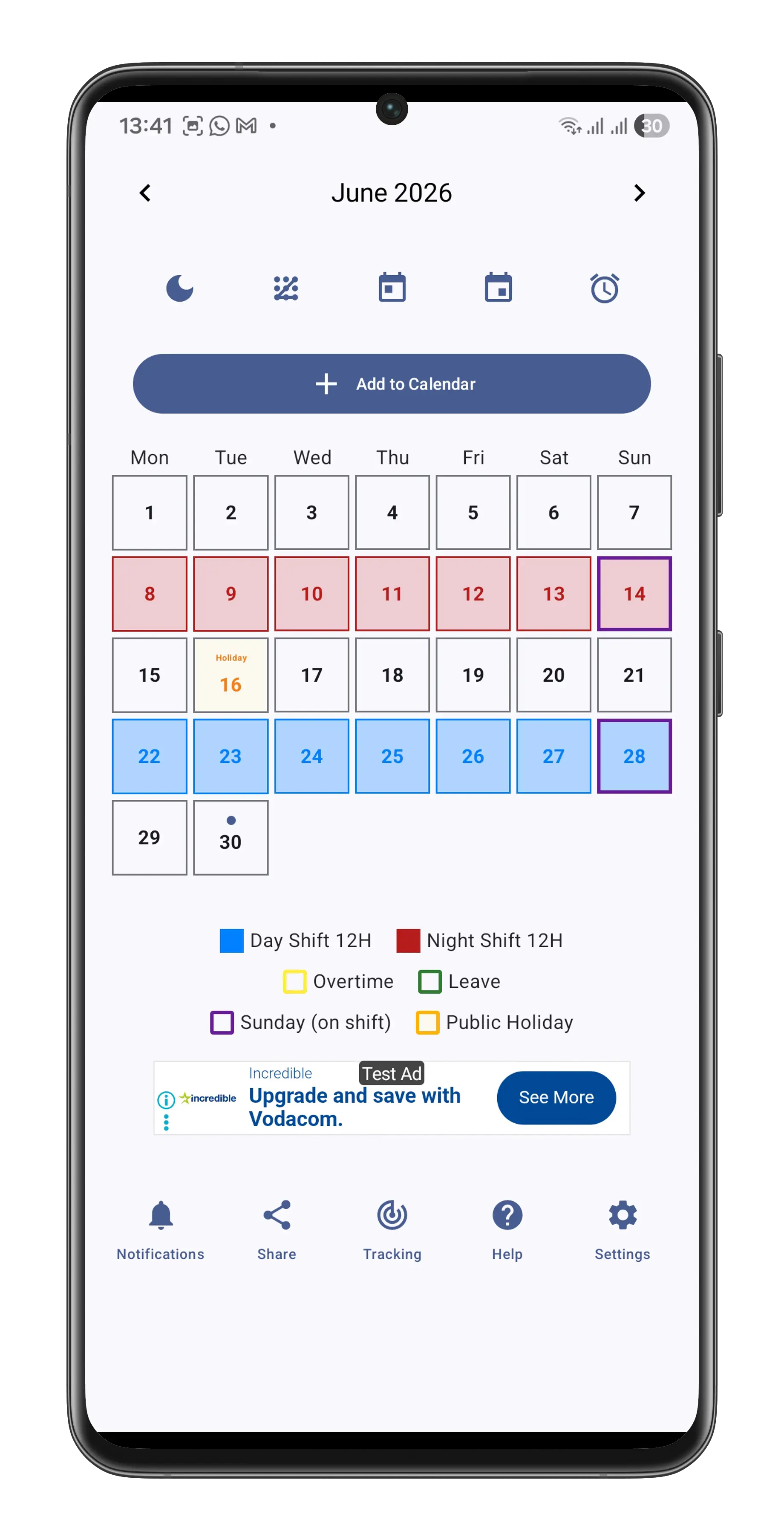
Set up the Pitman schedule in ShiftShow
- Open Smart Shift Builder and choose your first working day, for example a Monday.
- Add six blocks: 2 shifts, 2 off, 3 shifts, 2 off, 2 shifts, 3 off. Use day shifts for a day crew or night shifts for a night crew.
- If you are on the partner crew, start the same pattern one week later.
- Set your shift times and check the first fortnight against your roster.
ShiftShow then shows your shifts up to 20 years ahead. Use it to see your next long weekend, set the alarm that adjusts to each shift, and track overtime and leave.
Get ShiftShow for AndroidPitman schedule FAQ
What is the Pitman schedule?
A 14-day rotation of 12-hour shifts: two on, two off, three on, two off, two on, three off. Two crews work permanent days and two work permanent nights, with each pair working opposite days.
What is the difference between Pitman and Panama?
They share the same 2-2-3 rhythm. In these guides, Pitman means crews stay on days or nights permanently, and Panama means crews rotate between days and nights every two or four weeks. Employers do not always use the names the same way.
How many hours a week is the Pitman schedule?
Seven 12-hour shifts, 84 hours, per fortnight. With a Monday start you work five shifts one week and two the next, which averages 42 hours a week.
Does the Pitman schedule give every other weekend off?
Yes, when the fortnight starts on a Monday. Every other weekend is a three-day weekend from Friday to Sunday, 26 a year, for both day and night crews.
Is the Pitman schedule always 12-hour shifts?
With four crews covering 24/7, yes: each date needs one day crew and one night crew, so the shifts are 12 hours. Covering the clock with 8-hour shifts needs three shift types, and so more crews or a different pattern.
How many crews does the Pitman schedule need?
Four: two day crews and two night crews. Within each pair, one works while the other is off.
Can I choose days or nights on a Pitman rota?
That depends on your employer. Because crews are fixed, it is worth asking whether you can apply for a day or a night crew. HSE guidance encourages employers to offer a choice of permanent or rotating shifts and to try to avoid permanent night shifts.
Sources
- Teambridge, Panama schedule meaning (Pitman, Panama and 2-2-3 naming).
- HiveDesk, The 2-2-3 schedule explained (Pitman for the 2-2-3 sequence with teams on fixed day or night shifts).
- J. C. Miller, Shift Plans with Seven Consecutive Shifts, white paper, April 2012, on the website of the US DOT Pipeline and Hazardous Materials Safety Administration (PHMSA) (adaptation to night work).
- Health and Safety Executive, Good practice guidelines for shift work schedules (choice of permanent or rotating shifts; avoiding permanent nights).
- Health and Safety Executive, HSG256, Managing shift work (weekly and fortnightly rotation).
- Weekend and coverage figures worked out by ShiftShow from the sequences shown on this page.
Explore other shift patterns
4 On 4 Off Shift Pattern
Four days, four off, four nights, four off on a 16-day cycle, plus the fixed version with permanent day and night crews.
Read the guide →2-2-4: 2 Days, 2 Nights, 4 Off
An 8-day, four-crew rota with never more than two nights in a row, associated with UK fire and rescue services.
Read the guide →3-3-3: 3 Days, 3 Nights, 3 Off
A 9-day rota that covers 24/7 with only three crews, so each person works two days in every three.
Read the guide →7 On 7 Off (7 In 7 Out)
Week-long blocks of shifts, often 12 hours long, with a full week off between them.
Read the guide →DuPont Work Schedule
The classic 28-day, four-crew rotation with seven days off in a row every cycle.
Read the guide →Modified DuPont Schedules
Reverse DuPont, five-crew versions and other common changes, plus the 30-day 4-2-3-3-3-4-4-7 rotation used in manufacturing and chemical plants.
Read the guide →Panama Shift Pattern (2-2-3)
The 14-day 2-2-3 rhythm with crews rotating between days and nights and, with a Monday start, a three-day weekend every other week.
Read the guide →