
What is the difference between predictable and unpredictable shifts?
Predictable shifts follow a fixed, repeating pattern, such as 7 on 7 off or 2-2-4, so employees know their working days, days off and shift times months or years in advance. Unpredictable shifts are set week by week or month by month, often published only a few days ahead, and can change at short notice.
Most workplaces sit somewhere between the two. A team may work a fixed pattern most of the time but still have occasional extra shifts, swaps or changes. The aim is not to remove every change, but to make the normal schedule something people can rely on.
| Predictable shifts | Unpredictable shifts | |
|---|---|---|
| How the schedule is made | A repeating shift pattern, set up once | Built again every week or month |
| How far ahead employees know | Months or years | Often days or a couple of weeks |
| Changes at short notice | Rare | Common |
| Planning life outside work | Easy: childcare, study, travel and family time can be booked well ahead | Hard: plans wait until the next schedule is out |
| Manager’s time | Little: only leave, swaps and absences need handling | A lot: the whole schedule is rebuilt each time |
| Fairness | Built into the pattern: everyone shares weekends and nights by rotation | Depends on each new schedule, so it can feel unfair |
What research has found
Researchers in the United States have studied schedule predictability in large retail and food-service companies. Their findings point the same way: stable, predictable schedules are better for employees and for the business.
Stable schedules increased sales and productivity
In the Stable Scheduling Study, researchers from the University of California Hastings College of the Law, the University of Chicago and the University of North Carolina ran a randomised experiment in 28 Gap stores in the San Francisco and Chicago areas. Stores that gave staff more stable and predictable schedules saw median sales rise by 7% and labour productivity rise by 5%, compared with stores that kept their usual scheduling.
Unpredictable schedules were linked to worse wellbeing
The Shift Project, based at Harvard, surveyed 27,792 hourly workers at 80 large US retail and food-service companies. The researchers found that unpredictable schedules were associated with worse sleep quality, less happiness and more psychological distress. In their data, 43% of workers who had a shift cancelled reported feeling unhappy, compared with 26% of those who had not.
Unstable schedules were linked to staff leaving
A later Shift Project study followed 1,827 hourly retail and food-service workers over time. Among workers with relatively unstable schedules, schedule instability was a strong predictor of leaving the job. Lower job satisfaction and conflict between work and family life explained much of that link.
These studies looked at US retail and food service, where unpredictable scheduling is common. The same practical reasons apply in other industries: people can only plan their lives around a schedule they can see in advance.
Why predictable shifts are better for employees
- They can plan their lives. Childcare, school runs, medical appointments, study, sport, holidays and family events can all be booked weeks or months ahead.
- They can see their families. For people who work far from home, a predictable pattern such as 7 on 7 off shows exactly when the next week at home will be, so they can book travel early and spend their full rest days with loved ones without using leave.
- They know what they will earn. A fixed pattern means a steady number of shifts and hours, which makes budgeting easier.
- They can rest properly. Days off are known in advance and are not cut short by a new schedule or a last-minute call-in.
- It feels fair. Weekends, public holidays and less popular shifts come round in turn, rather than depending on who builds the schedule each week.
- Less stress. There is no waiting for next week’s schedule, and no rearranging of plans each time it changes.
Why predictable shifts are better for employers
- Less time spent scheduling. Building a schedule from scratch every week or month takes hours of a manager’s time. A repeating pattern is set up once, and only leave, swaps and absences need handling after that.
- Fewer mistakes and gaps. A pattern that has been checked for coverage keeps covering every shift, cycle after cycle. Each new hand-built schedule is another chance for a gap or double booking.
- Fewer last-minute swaps and no-shows. People who know their shifts months ahead can arrange their lives around them, so fewer clashes turn up at the last minute.
- Better staff retention. Research links unstable schedules to people leaving. Keeping staff saves the cost and disruption of recruiting and training replacements.
- Easier recruitment. A clear pattern, such as “2 days, 2 nights, 4 off” or “7 on 7 off”, is easy to explain in a job advert and attractive to candidates who want to plan their lives.
- Better results. In the Gap study, stores with more stable schedules sold more and were more productive.
The problems with working out shifts every week or month
Many teams still build a new schedule every week or month, usually because demand changes or because that is how it has always been done. The costs add up:
- Late schedules. When the schedule is rebuilt each time, it is often published only a few days before it starts, which leaves employees little time to plan.
- Constant juggling. Every new schedule means collecting availability again, resolving clashes again and checking coverage again.
- Uneven shares of good and bad shifts. Without a pattern, it is easy for the same people to end up with weekends, nights or holidays, which damages trust.
- Uncertain income. Hours that change from week to week make it hard for employees to budget.
- More questions and complaints. Employees ask when the next schedule will be out, why their shifts changed and whether they can swap, which takes up more of the manager’s time.
Keeping some flexibility in a predictable schedule
A predictable schedule does not mean a rigid one. Most workplaces need some flexibility for busy periods, absences and personal requests. These approaches keep the core schedule predictable while handling change:
- Fix the base, flex the edges. Cover normal demand with a repeating pattern, and use part-time staff, a relief pool or voluntary extra shifts for peaks.
- Plan cover for absence. Decide in advance how gaps will be filled, such as a relief rota or a list of volunteers for extra shifts, so absences do not force a whole new schedule.
- Allow shift swaps. Let employees swap shifts with each other, with a simple approval step, instead of rebuilding the schedule.
- Book leave against the pattern. Because everyone knows the pattern, leave requests can be made and approved months ahead.
- Review the pattern, not the week. If demand changes for good, change the pattern once, with notice, rather than reworking the schedule every week.
How to move from unpredictable to predictable shifts
- Look at your demand. Find the hours that must always be covered and how many staff each shift needs. Separate normal demand from occasional peaks.
- Work out how many people you need. Use the staff scheduling calculator to turn hours and staffing levels into a number of teams and employees.
- Shortlist patterns. Compare repeating patterns that cover your hours in the shift pattern table, such as 7 on 7 off, 2-2-4, 4 on 4 off, Panama or Pitman.
- Involve your employees. Explain the options, ask what matters to them, and let the team help choose. People are more likely to accept a pattern they helped pick.
- Run a trial. Use the new pattern for two or three full cycles, then review it together and adjust.
- Give everyone the schedule. Make sure each employee can see their own shifts months ahead. With ShiftShow, each person enters the pattern once and sees it on their phone for years ahead.
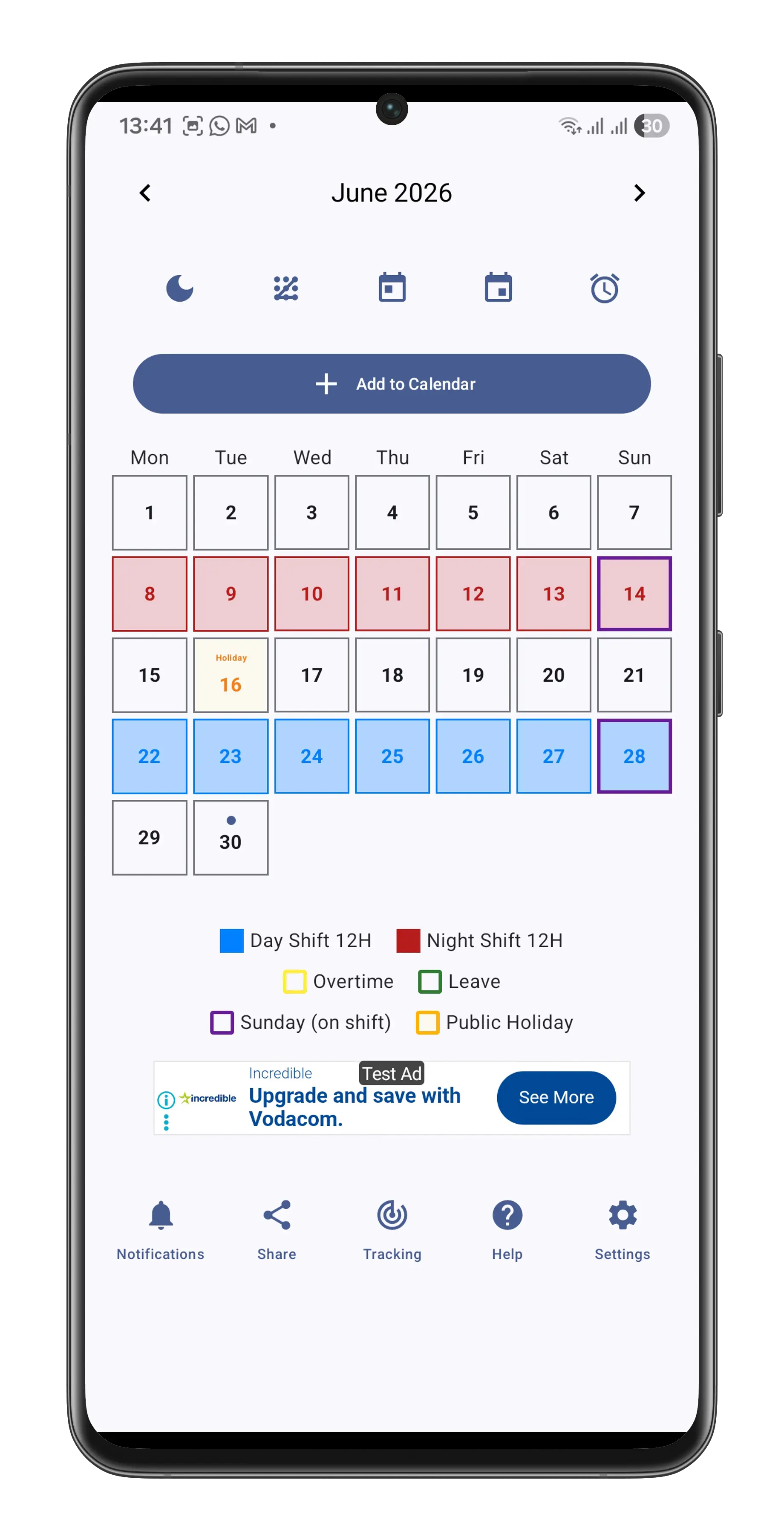
Make your shifts predictable with ShiftShow
ShiftShow is a free shift calendar app for Android, built for repeating shift patterns. Each employee enters their pattern once with the Smart Shift Builder, including rotating schedules, and the app shows their shifts on a colour-coded calendar up to 20 years ahead. A built-in alarm adjusts to each shift, so early, late and night shifts each get the right wake-up time.
Because the whole pattern is on everyone’s phone, nobody has to wait for next week’s schedule. Days off, weekends off and the next block of rest are always one tap away. Managers can combine employees’ ShiftShow hours exports in Manager’s Desk.
Download ShiftShow free on Google PlayPredictable shifts FAQ
What are predictable shifts?
Predictable shifts follow a fixed, repeating pattern, such as 7 on 7 off or 2-2-4, so employees know their working days, days off and shift times months or years in advance.
What are unpredictable shifts?
Unpredictable shifts are set week by week or month by month, are often published only a few days ahead, and can change at short notice.
Why are predictable shifts better?
Employees can plan childcare, study, travel and family time, know what they will earn, and share weekends and nights fairly. Employers spend less time building schedules, have fewer gaps and last-minute swaps, and keep staff for longer.
Do predictable schedules help the business?
Research suggests so. In a randomised study in 28 Gap stores, stores that gave staff more stable and predictable schedules saw median sales rise by 7% and labour productivity rise by 5%.
Can a predictable schedule still be flexible?
Yes. Cover normal demand with a repeating pattern, and handle peaks and absences with part-time staff, a relief pool, voluntary extra shifts and shift swaps, without rebuilding the whole schedule.
How do employees keep track of a repeating shift pattern?
With a shift calendar app such as ShiftShow. Each employee enters the pattern once and sees their shifts on their phone up to 20 years ahead, with an alarm that adjusts to each shift.
Sources
- Williams, J.C., Lambert, S.J. and Kesavan, S. (2018). Stable scheduling increases productivity and sales: the Stable Scheduling Study. Center for WorkLife Law, University of Chicago and University of North Carolina.
- Schneider, D. and Harknett, K. (2019). Consequences of routine work-schedule instability for worker health and well-being. American Sociological Review, 84(1), 82–114.
- Choper, J., Schneider, D. and Harknett, K. (2022). Uncertain time: precarious schedules and job turnover in the US service sector. ILR Review, 75(5), 1099–1132.